 SANDU DanielaVIEW PROFILE →
You Don't Win Every Day. You Still Have to Show Up.
Some of the most useful lessons about performance don't come from business. For me, many of them come from sport. Not from winning, but from everything that happens on the days when nobody is watching.
Some of the most useful lessons about performance don't come from business. For me, many of them come from sport. Not from winning, but from everything that happens on the days when nobody is watching.
I was thinking about this recently during a workout.
Nothing remarkable was happening. No competition. No finish line. No one to impress.
Just another training session.
And perhaps that is exactly the point.
We tend to associate performance with results: winning, achieving a target, getting promoted, completing a transformation, delivering a strong quarter.
But most performance is built somewhere else.
On ordinary days.
When progress is slow. When motivation isn't particularly high. When nobody is applauding. When you simply decide to do the work anyway.
After more than two decades working with leaders, teams and organizations, I see a strong parallel with business.
You don't win every day. But you still have to show up.
We see the result. We rarely see what built it.
Sport is very honest about results.
There is a score. A time. A ranking. Someone wins and someone doesn't.
But what we see is only the visible part.
Behind one good performance there are hundreds of hours that nobody sees.
Training.
Repetition.
Bad days.
Small improvements.
Setbacks.
Starting again.
Careers and businesses are not so different.
We notice the promotion, the successful project, the new role, the company that grows, the leader who seems to be doing exceptionally well.
We don't always see what came before.
The difficult decisions.
The mistakes.
The opportunities that didn't happen.
The conversations that didn't go as planned.
The work that produced no immediate recognition.
And the days when someone simply kept going.
I have become increasingly convinced that what we do on those days matters more than we think.
Motivation is useful. Discipline is more reliable.
Motivation gets a lot of attention.
But motivation is inconsistent.
Some mornings I want to train. Others, less so.
Work is no different.
There are projects that energize us immediately and others that require patience. There are periods when everything seems to move and periods when progress feels frustratingly slow.
If performance depended entirely on motivation, very little of substance would ever get finished.
Discipline is different.
It is less exciting, but far more dependable.
It means preparing properly even when you have done it a hundred times before.
Having the difficult conversation instead of postponing it.
Learning something new when it would be easier to stay with what you already know.
Doing good work even when nobody is paying particular attention.
And returning after something did not go the way you wanted.
Motivation helps us start. Discipline is often what allows us to continue.
Not every bad result requires a new strategy
This is another thing I like about sport.
You can prepare well and still lose.
Sometimes you made mistakes.
Sometimes the strategy was wrong.
And sometimes the person competing against you was simply better that day.
A good coach needs to understand the difference.
Organizations do too.
In business, we sometimes react very quickly to a disappointing result.
A quarter is weaker than expected and we reconsider the strategy.
A transformation takes longer than planned and we start questioning the approach.
A new initiative does not deliver immediately and we replace it with another one.
Sometimes that is exactly what leadership requires.
But sometimes the harder decision is to stay with something long enough for it to work.
I have seen both mistakes over the years: organizations holding onto something long after the evidence says it needs to change, and organizations changing direction so frequently that nothing has enough time to produce a result.
There is no simple formula for knowing which situation you are in.
That is where judgment comes in.
When do we need the courage to change direction, and when do we need the discipline to stay the course?
For me, that is one of the less discussed parts of leadership.
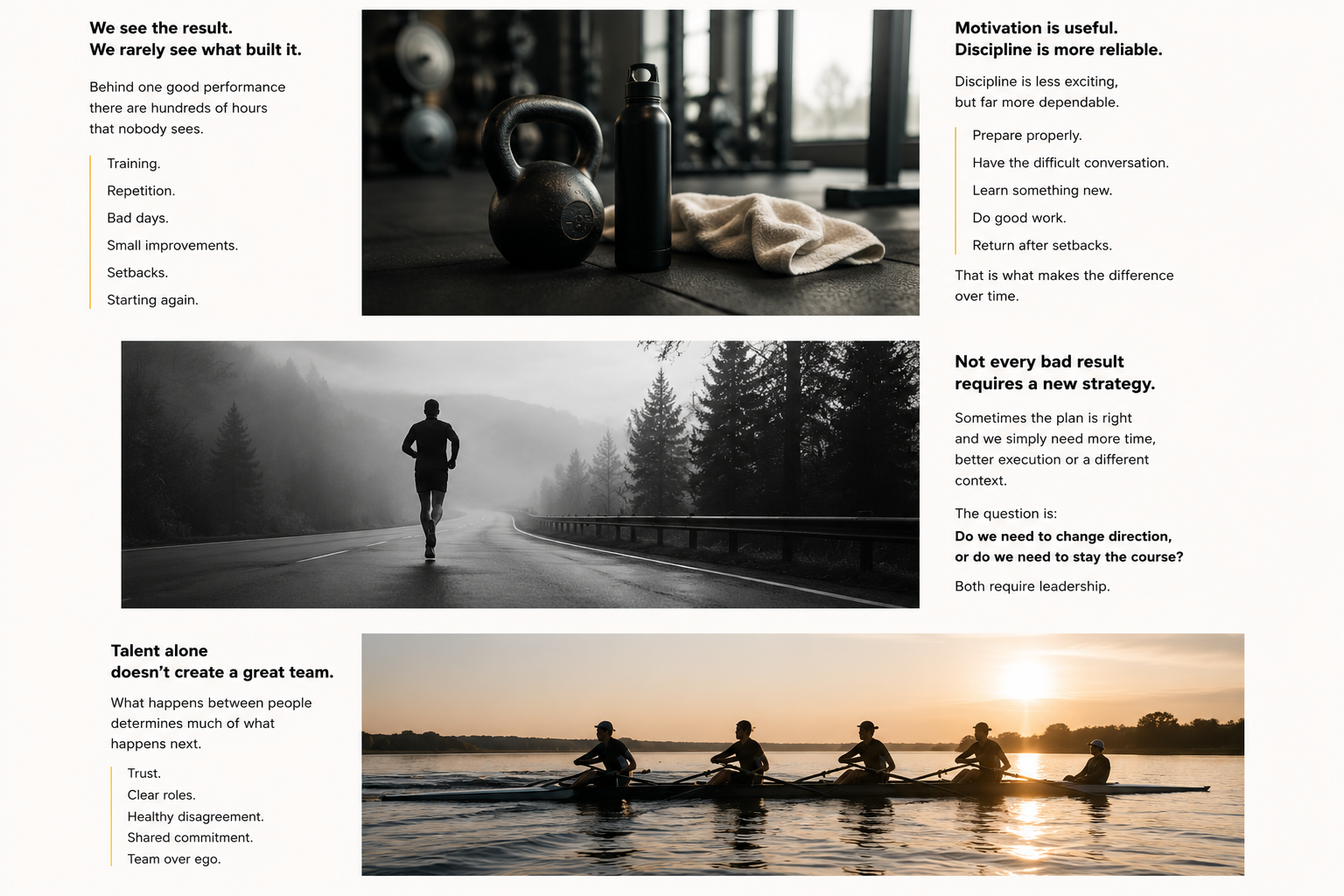
Talent alone doesn't create a great team
There is another connection between sport and organizations that I find difficult to ignore.
The best individual players do not automatically create the best team.
Neither do the best individual professionals.
Organizations spend a great deal of time trying to attract talented people. Of course that matters.
But talent is only the starting point.
What happens between people determines much of what happens next.
Do they trust each other?
Are roles clear?
Can they disagree without making disagreement personal?
Do they know who makes the decision?
What happens when the pressure increases?
Can a strong performer make space for somebody else to succeed?
These questions matter in a sports team.
They matter just as much around a leadership table.
I've worked with teams containing exceptionally capable individuals that struggled to perform collectively. I've also seen teams without obvious “stars” achieve remarkable things because people knew their roles, trusted each other and were genuinely committed to a common result.
Individual capability matters. Collective performance is something we have to build.
What happens after a setback tells us a lot
Winning is interesting.
But I sometimes think losing tells us more.
When things are going well, confidence comes relatively easily.
A setback changes the conversation.
Do we look for somebody to blame?
Do we question everything?
Do we become defensive?
Or can we look honestly at what happened, learn what needs to be learned and come back?
The same is true in a career.
Most of us, if we work long enough, will experience moments that don't go as planned.
A role we wanted and didn't get.
A decision that turned out to be wrong.
A project that failed.
A business result that disappointed us.
A change we didn't choose.
I don't believe we need to turn every difficult experience into an inspirational story.
Sometimes disappointment is simply disappointment.
Sometimes we need time to process it.
But one result — good or bad — is rarely the whole story.
A career is shaped not only by what we do when things are going well, but also by how we respond when they aren't.
Showing up doesn't mean standing still
There distinction here.
Showing up is not about repeating the same thing indefinitely.
It isn't stubbornness.
And it certainly isn't pretending that everything is fine when it isn't.
For me, showing up means staying engaged enough to learn.
Adjust when necessary.
Ask better questions.
Keep the discipline when motivation disappears.
Accept that progress will not always be linear.
And have enough self-awareness to recognize when something genuinely needs to change.
Perhaps this is the lesson from sport that stays with me most.
It doesn't promise that hard work will always produce the result we want.
It doesn't.
There are too many things we cannot control.
But we can control more than we sometimes think.
How well we prepare.
How consistently we work.
What we learn from a difficult result.
How we treat the people around us when the pressure is high.
And whether we come back the next day.
In sport, after a win comes another training session.
After a loss?
Another training session.
I like that simplicity.
Maybe our careers need a little more of it too.
We don't need every day to prove that we are successful.
We don't need every effort to produce an immediate result.
And we don't need every setback to become a verdict on what we are capable of.
Sometimes we just need to keep building.
Keep learning.
Keep adjusting.
And show up again.
Because performance is not only about who we are on the days we win.
It is also about who we become on all the days in between.