 SANDU DanielaVIEW PROFILE →
Children Fail Differently. Maybe We Should Too.
My son has a 3D printer.
My son has a 3D printer.
He can spend hours designing something, changing dimensions, testing an idea and waiting for the printer to turn what he has on a screen into something he can actually hold in his hands.
Sometimes it works beautifully.
Sometimes it doesn't.
A piece doesn't fit. The proportions are wrong. The print fails halfway through. Or the final result simply isn't what he imagined.
Then he does something that I find increasingly interesting.
He starts again.
No long analysis of whether he is talented enough. No embarrassment because the first version didn't work. No conclusion that perhaps he should stop trying.
He looks at it, figures out what could be different, changes the design and prints another version.
Some attempts end up on his desk.
Others end up in recycling.
But almost all of them teach him something.
Watching this made me think about how differently children and adults experience failure.
Somewhere along the way, failure becomes personal
Think about how children learn most things.
A child learning to ride a bicycle falls and gets back on.
A child building something sees it collapse and starts rebuilding.
A child learning a new game doesn't expect to be good at it immediately.
They expect to learn by doing.
Of course, they get frustrated. They can be disappointed. They sometimes want to give up.
But there is often something wonderfully uncomplicated about their response:
It didn't work. Let's try again.
As adults, particularly in professional life, we tend to make failure much more complicated.
A project doesn't deliver what we expected.
An idea is rejected.
We don't get the role we wanted.
A presentation goes badly.
We make a decision that turns out to be wrong.
We launch something and nobody seems interested.
And very quickly, what happened can become a judgement about who we are.
Maybe I'm not good enough.
Maybe I wasn't ready.
Maybe I shouldn't have tried.
What will people think?
The event hasn't changed.
The meaning we attach to it has.
We become better at succeeding — and sometimes worse at failing
There is a paradox I've noticed in professional life.
The more experienced we become, the more we are expected to know.
That is reasonable.
Experience should improve our judgement.
But seniority can also make it harder to admit that we don't know something, that an idea didn't work or that we need to change direction.
Early in our careers, being in learning mode feels normal.
Later, competence becomes part of our identity.
We have a title. A track record. A reputation. People expect answers from us.
And without noticing it, we can start protecting the image of being competent rather than remaining open to the discomfort of learning.
That can show up in very small ways.
We don't ask the question because we think we should already know the answer.
We keep investing in a project because stopping it would mean admitting the original decision was wrong.
We defend an idea longer than we should because it was our idea.
We avoid trying something new because we may not immediately be good at it.
And sometimes we call this experience.
But experience should make us better at dealing with uncertainty, not more afraid of it.
Children are naturally good at iteration
What I see with my son and his 3D printer is essentially iteration.
Design.
Print.
Look at the result.
Change something.
Print again.
It sounds obvious when we describe a child's project.
Yet this is also how many of the best things in business are built.
A strategy rarely survives contact with reality completely unchanged.
A transformation doesn't follow the original PowerPoint slide perfectly.
A new organizational structure may look logical on paper and reveal problems once people begin working within it.
A new product doesn't become successful simply because the original idea was good.
A leader entering a bigger role discovers that some of the behaviours that made them successful before no longer work.
We test.
We learn.
We adjust.
We continue.
The difference is that organizations sometimes make this process unnecessarily difficult because we treat changing direction as evidence that somebody got something wrong.
But changing your mind after receiving new information is not necessarily inconsistency.
Sometimes it is good judgement.
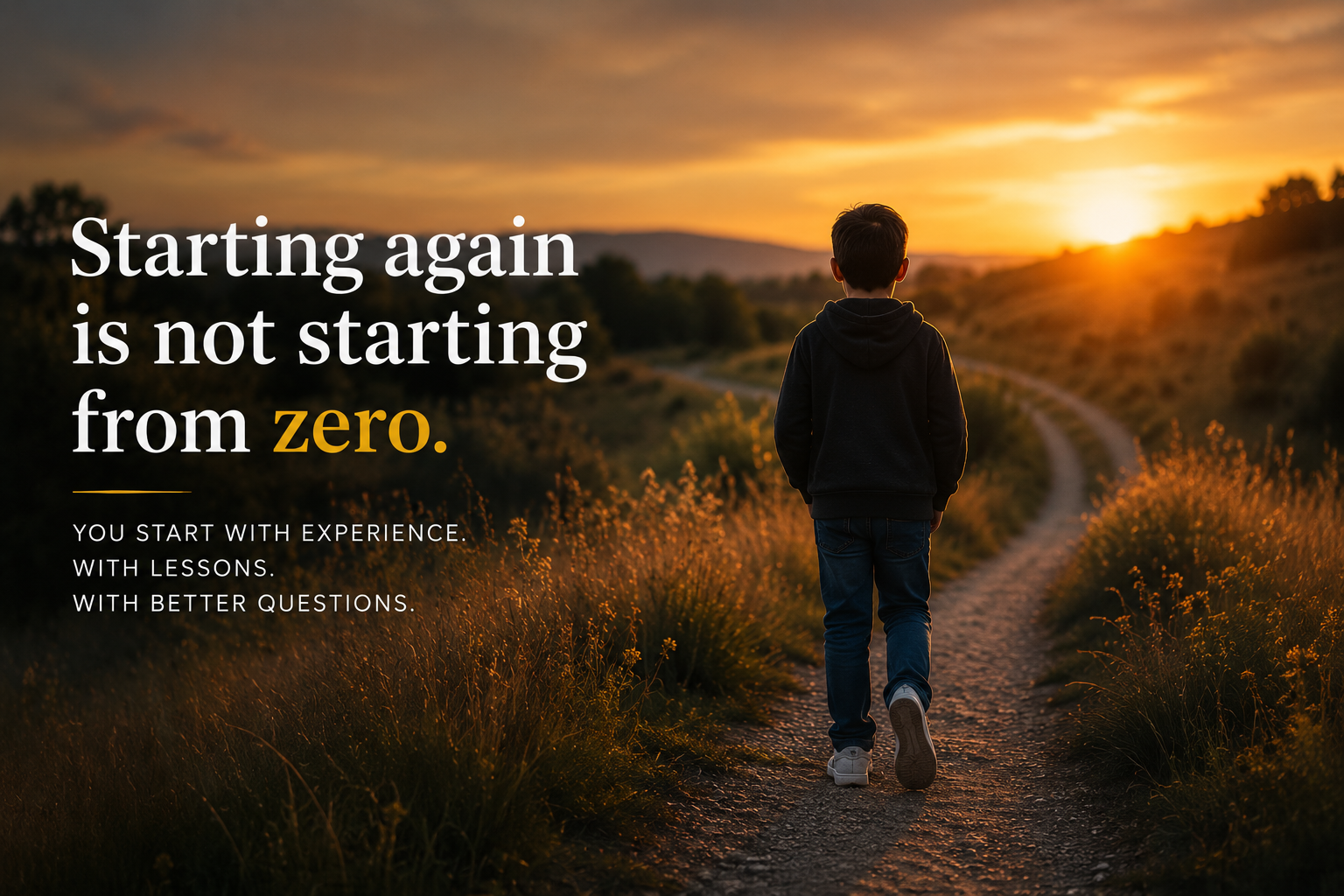
Starting again doesn't mean starting from zero
This may be the lesson I like most.
When Matei redesigns something after a failed print, he isn't really starting from the beginning.
The second version contains what he learned from the first.
He knows that a piece needs to be thicker.
That an angle doesn't work.
That two components don't fit.
That what looked right on the screen doesn't necessarily work in the physical object.
The failed version is still part of the successful one.
I think we forget this about our own lives.
When a project fails, we don't return to zero.
When a career decision turns out differently from what we expected, we don't return to zero.
When we have to rebuild a team, rethink a strategy or leave something behind, we don't return to zero.
We start again with information we didn't have before.
With experience.
With better questions.
Sometimes with a little more humility.
And, hopefully, with better judgement.
Starting again is not the opposite of progress. Sometimes it is exactly how progress happens.
There is a leadership lesson here too
Organizations often say they want people to experiment.
We ask for innovation.
Initiative.
Entrepreneurial thinking.
Ownership.
We tell people to challenge the status quo.
But employees don't decide whether an organization truly believes these things by reading the values on a wall.
They watch what happens when somebody tries something and it doesn't work.
Does the first question become:
Who approved this?
Who is responsible?
How did this happen?
Or do we also ask:
What did we learn?
What would we do differently?
Was the assumption wrong, or was the execution wrong?
What should we test next?
There is obviously a limit.
Resilience is not an excuse for carelessness. Repeating the same mistake without learning from it isn't experimentation. And accountability still matters.
But there is an important difference between a mistake caused by negligence and an intelligent attempt that did not produce the expected result.
Leaders need to know the difference.
Because people learn very quickly what failure costs them.
If every unsuccessful attempt damages their reputation, they adapt.
They stop experimenting.
They bring safer ideas.
They ask for more approvals.
They wait for somebody else to make the difficult decision.
And eventually the organization becomes very good at avoiding mistakes.
It may also become very bad at changing.
Curiosity may be one of the most underrated forms of resilience
We usually associate resilience with strength.
Endurance.
Getting through difficult periods.
Getting back up after something goes wrong.
All of that is true.
But watching children makes me think that resilience also has a quieter ingredient:
curiosity.
Instead of:
Why did I fail?
try:
Why didn't this work?
Instead of:
What does this say about me?
try:
What is this telling me?
Instead of:
Should I give up?
perhaps:
What would I change if I tried once more?
The difference looks small.
It isn't.
One set of questions judges the person.
The other examines the problem.
And when we become curious about a setback, it becomes much easier to learn from it.
Perhaps our children are reminding us of something we already knew
As parents, we spend a lot of time thinking about what we should teach our children.
Discipline.
Patience.
Responsibility.
Confidence.
Perseverance.
The ability to work for something rather than expect it immediately.
But I increasingly think the learning goes both ways.
Children remind us what it looks like to be a beginner.
To ask questions without worrying whether they make us look uninformed.
To make something simply because we want to see whether we can.
To fail without turning every failure into a verdict on our ability.
And to try again without needing a guarantee that the next attempt will work.
A few days ago, another print didn't turn out the way Matei wanted.
He looked at it, explained to me what was wrong and started thinking about the next version.
Nothing dramatic had happened.
One version simply hadn't worked.
There was another one to make.
Maybe that is the part worth remembering.
Not every attempt will work.
Not every decision will be right.
Not every plan will survive reality.
And not everything we start will become what we originally imagined.
But an unsuccessful attempt doesn't always mean stop.
Sometimes it simply means:
learn something, change something, and start again.
Perhaps resilience isn't something we need to learn from scratch.
Perhaps it is something children can help us remember.